 Pirateswap
 crypto deposits for buying skins
Pirateswap crypto deposits fund Counter-Strike 2 (CS2) skin purchases when an available top-up method accepts and credits the cryptocurrency payment. Current supported assets, network choices, minimum amounts, and refund eligibility remain unconfirmed. The payment amount, transfer costs, and resulting spending credit determine whether the deposit covers the intended purchase. An on-chain transaction identifier can locate a transfer; the spending balance shows whether its funds are usable.
Updated:
Before committing funds, identify the balance the skin purchase accepts and the terms attached to the selected payment request. Cryptocurrency transfer, purchase credit, and item delivery each describe a different part of the purchase.
A completed top-up gives the intended skin purchase usable credit; a wallet submission notice alone does not establish broadcast or account credit.
Wallet funds and purchase credit
The sending wallet supplies cryptocurrency, while purchase credit represents the value Pirateswap accepts toward the chosen skin. The payment request connects those amounts through its conversion and crediting terms. A wallet's displayed currency valuation can differ from the amount a payment service requests, because each service may use a different exchange rate.
Compare the skin's quoted purchase price with any existing eligible credit in the same account currency. Cryptocurrency units, the wallet's currency estimate, and account credit have different meanings. Combining them directly produces a misleading shortfall. The top-up needs to fund the balance the particular purchase uses.
Refundability and unused deposit credit
Unused purchase credit does not automatically carry a right to a cryptocurrency refund or cash-out. Those permissions depend on the deposit and balance terms. If retaining access to unused money matters, a refundable top-up needs explicit terms before it can serve that purpose.
A settled on-chain payment cannot ordinarily be recalled by its sender. An approved refund requires a separate return payment or another remedy the applicable terms allow. The applicable terms decide whether cancelling a skin purchase also qualifies the original payment for a refund. For a reserved skin made unavailable by a Steam trade reversal, Pirateswap described replacement items or a purchase-price refund to site balance in a January 2026 public reply. That balance refund does not return the original cryptocurrency payment. Dust3's review, updated 24 August 2026, reported that deposited funds and promotional credit could fund skin trades or Store purchases, while cash-out required skin sales. Current cash-out eligibility for deposited funds remains unconfirmed. A sale-payout option concerns sale proceeds unless the balance rules also permit withdrawing deposited funds.
Asset support and network compatibility
A payment method must accept both the cryptocurrency you send and the network carrying the transfer. CS2WH's walkthrough, updated 26 September 2026, listed Bitcoin, Ethereum, Litecoin, Dogecoin, USDT, USDC, Solana, Tron, and Chainlink for top-ups. An asset may exist on several networks, while a particular receiving service accepts only some of them. Matching the token name therefore leaves network compatibility unresolved.
Use the network and destination attached to the selected payment request. Address formats can overlap across networks, so the receiving method's network choice matters even when an address looks familiar. Where the request includes a destination tag or memo, that additional value helps assign the payment to its intended recipient.
What amount needs to reach the payment address?
The payment address needs to receive the cryptocurrency amount the selected request requires, with any fee treatment handled as the sending service specifies.
Distinguish the amount deducted from the wallet from the amount delivered to the recipient. A sending service may charge its fee separately or deduct a withdrawal fee from the entered amount. Its final transfer preview determines which meaning applies; the label on an amount field alone can be ambiguous.
If the request gives a cryptocurrency amount, entering an independently calculated currency equivalent can produce a short payment. Exchange rates can differ between the wallet and the payment request. Use the requested units, and retain the conversion terms applying to that payment.
A minimum deposit, where imposed, concerns the receiving method's acceptance condition. The sender can also impose its own transfer minimum or limit. These restrictions apply at different ends of the payment. A transfer the wallet allows may still fail to satisfy the receiving request.
Promotional credit and the skin purchase total
A deposit promotion changes purchasing capacity only through the credit its conditions actually grant. If the payment request offers extra credit, establish whether it applies to the purchase you intend to make. Applicable charges and adjustments can change the final balance shown alongside a promotion.
The relevant comparison is the cryptocurrency cost of obtaining enough eligible credit for the skin's quoted price. Compare the same item and condition across the offers under consideration. Extra account credit does not establish a lower purchase cost when the quoted skin price also differs.
When has a crypto top-up finished?
A crypto top-up has finished when the accepted payment becomes usable credit in the balance the intended skin purchase accepts.
A sending service can acknowledge a withdrawal before broadcasting it. A transaction identifier can locate an on-chain transfer, while network confirmations describe its progress. The receiving method must also match the accepted payment to the intended account and make its purchase credit spendable.
The receiving method may wait for a specified confirmation requirement before crediting a payment. Its processing can add time beyond the blockchain transfer. Pirateswap's deposit-specific processing duration and confirmation requirements remain unconfirmed. Any requirement displayed for a selected method applies within that method's stated conditions.
The cryptocurrency can settle while the skin remains subject to its own trading restrictions. An account balance answers whether spending funds are available; the skin's delivery status answers whether the item has reached the intended inventory.
Changing the transfer network before payment
In this hypothetical skin purchase, the payment request accepts one network, and the sending wallet initially selects a different network. The desired skin and crypto asset stay unchanged. The request's amount and other payment conditions also remain satisfied in the comparison.
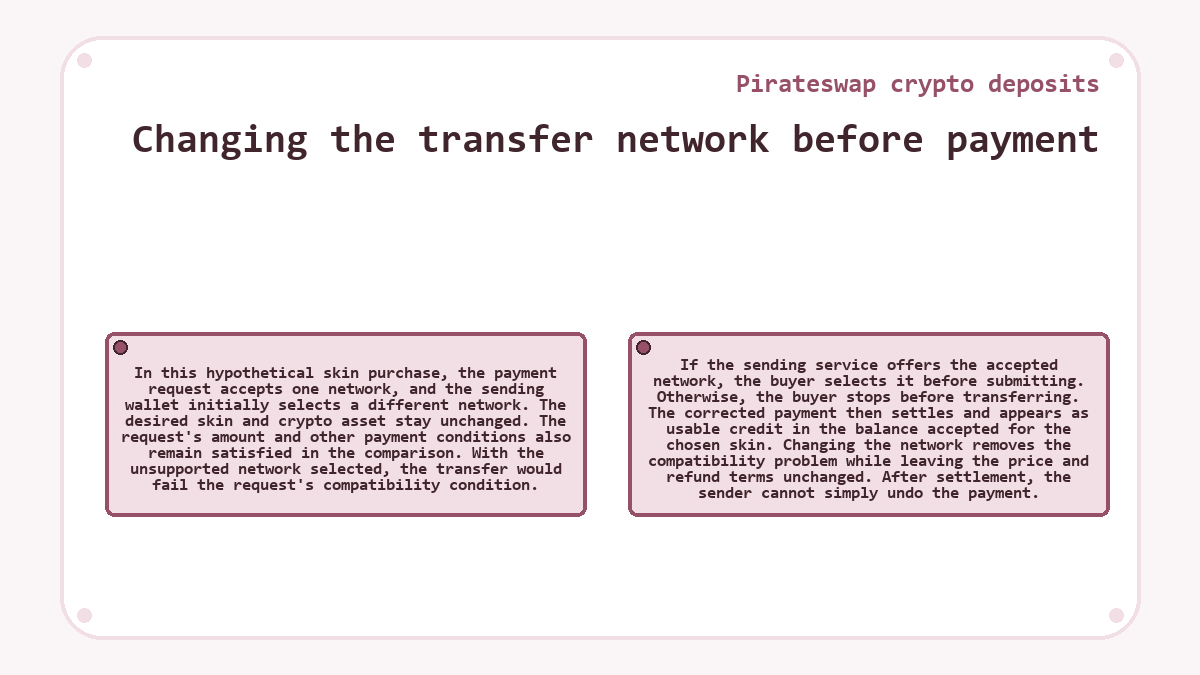
With the unsupported network selected, the transfer would fail the request's compatibility condition. If the sending service offers the accepted network, the buyer selects it before submitting. Otherwise, the buyer stops before transferring.
The corrected payment then settles and appears as usable credit in the balance accepted for the chosen skin. Changing the network removes the compatibility problem while leaving the price and refund terms unchanged. After settlement, the sender cannot simply undo the payment.
Purchase funding and skin availability
A funded account cannot override Steam trading restrictions on the recipient account or the selected skin. Steam's Trade Protection rules prevent CS2 items received in a trade from being traded onward for seven days. Account restrictions and item restrictions affect delivery separately. Before adding money solely for one skin, consider whether its availability and trade eligibility meet your purchase timing. A catalogue price describes the offered cost, while a restriction can still prevent immediate receipt. Deposit processing and any item waiting period apply to different objects.
Details for an uncredited payment
An uncredited payment needs enough information to distinguish a transfer failure from an account-crediting problem. Retain the payment request, transaction identifier, sent asset, network, destination, received amount, and time. Where the sender deducts charges, record both the wallet debit and recipient amount. A screenshot showing only the wallet's currency valuation does not identify what the recipient received.
A confirmed transaction with missing purchase credit requires a different explanation from a withdrawal the sender has never broadcast. Ask about the uncredited transfer using its payment details. A second transfer is not a universal fix: duplicate payments create additional funds to reconcile without correcting an address or network mismatch.
Public transaction details and wallet secrets
Payment tracing uses transaction and destination details; it does not require the secret used to restore a wallet. A recovery phrase can give another person control of the wallet accounts it restores. Keep recovery phrases and private keys out of deposit forms, support messages, and payment screenshots.
On public blockchains, a transaction identifier can expose addresses and transfer amounts. Sharing it may connect your account enquiry to that visible activity. Crop unrelated balances and transactions from screenshots, while preserving the details needed to locate the deposit. Payment records provide transfer information without granting access to the sender's wallet.
What to know about Pirateswap crypto deposits
Can I send a small test amount to a Pirateswap deposit address?
Use a test payment only if the selected payment method permits separate transfers at that amount. A payment below its minimum or smaller than a fixed request may remain uncredited or underpaid. A successful test also does not lock the asset's conversion rate, preserve a later quote, or establish refund eligibility for a larger payment.
What should I do if a Pirateswap crypto payment request expires?
Stop before sending against an expired payment request. If you still intend to fund the purchase, use a valid request and its current amount, destination, and network. If you already sent the payment, retain the transfer details and ask how that expired request will be handled. Expiry alone does not establish an automatic refund.
May I reuse an address from an earlier Pirateswap crypto deposit?
Use the destination supplied for the new Pirateswap crypto payment request. An address from an earlier top-up is suitable only where the selected method explicitly allows reuse. The asset name can stay unchanged while the applicable payment details differ. A destination saved in a wallet address book does not preserve an earlier request's terms.
Does scanning a QR code establish compatibility for a Pirateswap crypto deposit?
For a Pirateswap crypto deposit, compatibility depends on the network the sending wallet selects and the network the receiving method accepts. If the method supplies a QR code, compare its decoded destination with the payment request. A successful scan shows that the wallet can read the code. Check that the prepared transfer uses the network the receiving method accepts.
Can a sending exchange block a Pirateswap top-up before transferring it?
A sending exchange can prevent a transfer through its own withdrawal restrictions, even when a receiving payment request exists. Available balances, transfer limits, security holds, and supported withdrawal networks can affect whether it will send. Those conditions belong to the sending service. The payment request describes receiving conditions; the sender's transfer status describes whether cryptocurrency has left the exchange.
Would an approved Pirateswap deposit refund return the same crypto amount?
An approved Pirateswap deposit refund returns the amount its terms specify, which can use a different denomination from the original payment. The conversion basis, fees, and return method also affect what you receive. Account credit and a cryptocurrency return have different destinations. Current deposit refund eligibility and valuation terms remain unconfirmed, so neither form should be assumed.