 Pirateswap
 Skin Prices for Swaps and Cash Sales
Pirateswap skin prices describe different exchanges: trading Counter-Strike 2 (CS2) items for replacement skins or selling them for proceeds. A swap comparison needs the offered value of outgoing inventory and the price of the desired replacement. A cash-sale comparison needs the sale offer and any applicable payout deductions. Item characteristics and Steam trading restrictions also affect whether two offers are comparable. The useful comparison is the amount required to obtain an equivalent replacement or the net proceeds from selling. A larger displayed inventory valuation alone does not establish a better deal.
Updated:
In short: A refund at the original purchase price can leave a price gap when an equivalent replacement skin costs more.
The outgoing valuation and replacement price
Outgoing inventory contributes one side of a swap quote, while the selected replacement contributes the other. Both prices affect the additional value the exchange requires. A generous offer for your existing skin provides limited information until the replacement price is clear. Cash sales direct the comparison toward proceeds from the item being sold. Keep the intended outcome attached to each number: a valuation useful for replacing inventory does not automatically describe what a sale would pay.
How much does a skin swap actually cost?
A swap's quoted price gap is the replacement price minus the outgoing valuation, expressed in the same currency. A positive result describes additional value required by the quote. If those prices already include trading charges, adding those charges to the price gap again counts the same cost twice.
Surrendering a skin also has an opportunity cost: the proceeds available from selling it instead. A small additional payment can accompany surrendering a valuable item. Comparing only the payment leaves that item out of the calculation. Compare equivalent replacements and the same outgoing inventory across offers.
Percentages need a defined calculation base. A percentage of the replacement price differs from a percentage of the outgoing skin's cash value. Likewise, a difference between asking prices describes a price comparison, while a separately charged commission describes a deduction. Calling both figures a fee hides their different meanings.
A negative price gap does not establish that any remaining exchange value is available for withdrawal.
Sale offers, deductions, and net proceeds
A cash-sale offer values the skin being sold; the net payout describes the amount due after applicable deductions. Separate charges already reflected in the offer from charges applied afterward. When an offer explicitly excludes a payout deduction, subtract that deduction to calculate net proceeds. When the quoted amount already includes it, use the net figure without subtracting it again.
A gap between a sale offer and a market benchmark is not automatically a separate charge. It measures how the offer compares with that benchmark. Applying the gap again as a deduction understates the offer. For any crypto withdrawal option, a currency-denominated skin price and an amount in payout units also need the applicable conversion rate. Compare equivalent units before judging the amount due.
Replacement credit and sale proceeds in a worked comparison
A skin owner wants to compare obtaining a replacement with taking sale proceeds. In this hypothetical comparison, every amount uses the same currency units.
The swap quote values the outgoing skin at 47.82 and the replacement at 59.64. Their difference is 11.82, the additional value required for that replacement. These prices already include the charges built into the exchange quote.
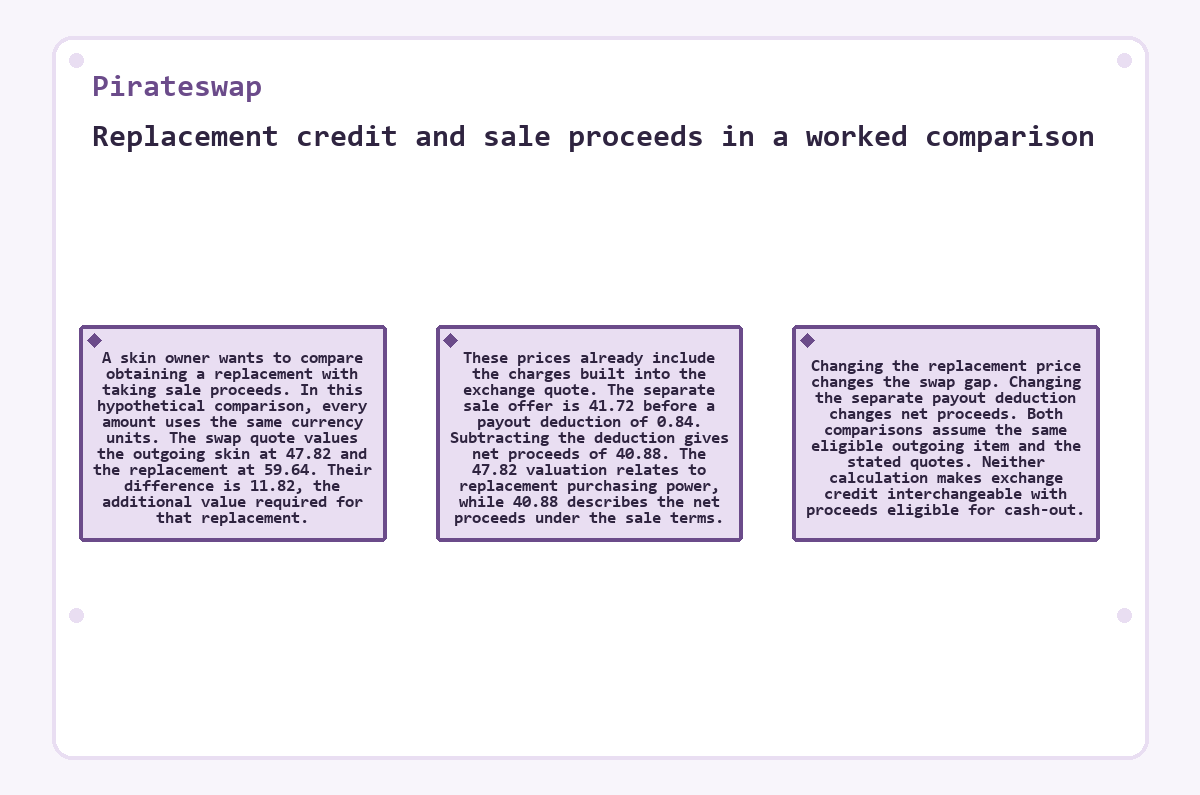
The separate sale offer is 41.72 before a payout deduction of 0.84. Subtracting the deduction gives net proceeds of 40.88.
The 47.82 valuation relates to replacement purchasing power, while 40.88 describes the net proceeds under the sale terms. Changing the replacement price changes the swap gap. Changing the separate payout deduction changes net proceeds. Both comparisons assume the same eligible outgoing item and the stated quotes. Neither calculation makes exchange credit interchangeable with proceeds eligible for cash-out.
Matching skin details before comparing prices
An item comparison needs the same weapon finish and relevant characteristics, not merely the same weapon name. Wear value, often called float, describes the finish's wear level. Pattern details describe its appearance. Weapon finishes can have different wear patterns even at the same wear value. An attractive appearance does not by itself establish a premium in a particular offer.
The exact replacement matters when appearance motivates the exchange. A broadly similar listing might have another wear value or pattern. Its price can provide context without pricing the specific item you want. Keep the actual quoted item separate from the broader price category used as a benchmark.
Steam marks CS2 items Trade Protected for 7 days after receipt in a trade. During that period, owners can equip and use them in-game, but cannot transfer, modify, or consume them. This restriction governs item movement; it does not set a standard skin discount or external payout deadline.
What happens to the price if a selected skin becomes unavailable?
Pirateswap's June 8, 2026 public response described refunds at the original purchase price for reversed trades. For an unavailable skin, it described a choice of refund at that price or replacement skins. A later replacement can have a different asking price. Returning the original value therefore does not ensure that the same amount buys the same kind of skin again.
Market conditions, demand, and item availability affect the service's prices. If a refund goes to site balance, a replacement can cost more than the returned credit. That gap can require additional funds or items. The amount credited back records the returned value; the later quote determines the cost of the replacement then available.
Steam Wallet prices and cash-sale benchmarks
Steam Community Market prices concern Steam Wallet transactions, which have a different spending destination from an external payout. Steam Community Market sale proceeds cannot be withdrawn to a bank or third-party account. Steam also separates the buyer's total payment from the seller's receipt through transaction and game-specific fees. Comparing a buyer's displayed asking price with another service's net sale offer mixes opposite sides of a sale.
An asking price records what a seller requests, while a buy order records what a buyer offers. A completed sale records an actual transaction. The Community Market lets sellers accept an available buying price or seek a higher price and wait. An unfilled listing does not establish sale proceeds.
Direct swapping versus selling before replacement
Selling and buying separately has a combined cost: the replacement purchase price minus net sale proceeds, plus any excluded charges. A direct swap has its own outgoing valuation and replacement price. Either comparison needs an equivalent replacement. A higher outgoing valuation can accompany a higher replacement price, while a lower sale offer can accompany a cheaper purchase elsewhere.
A direct swap keeps outgoing inventory and replacement stock together in one pricing decision. Separate selling and buying allows different counterparties, with each transaction's pricing and availability. Obtaining another particular skin calls for comparing complete replacement costs. Taking proceeds calls for comparing net sale amounts in equivalent units, with the applicable payout terms.
What to know about Pirateswap
-
Can I remove a sticker and sell it separately to increase my skin-sale proceeds?
- Removing an applied CS2 sticker permanently destroys it and does not return a tradable sticker to your inventory. Its unapplied market price cannot be added as a separately recoverable item in a sale. A quote for a decorated weapon concerns that weapon with its existing appearance. Judge its offered value without treating the applied sticker as another item you can cash out.
-
What should I retain if I dispute a Pirateswap skin quote?
- Keep the quote, the exact item's identifying details, and the transaction record for a pricing dispute. The record should distinguish a swap valuation from a sale offer and show the currency and any stated deductions. If a replacement becomes unavailable, retain the original quote and any refund record or replacement offer. Send relevant transaction information to support; passwords and authentication codes are unnecessary for explaining a valuation.
-
Why does my Steam price benchmark use a different currency from a Pirateswap quote?
- When you are signed in, Steam displays Community Market prices in the currency of your Steam Wallet. For listings originally priced in another currency, Steam applies an exchange rate it updates daily. Another service can use a different quote currency or conversion basis. Put the amounts in one currency before comparing them, preserving any conversion charges and the time the quoted rate applies.
-
Will saving a Pirateswap quote keep its price available?
- Saving a quote preserves its stated amount, while any price reservation depends on the offer's validity terms. A screenshot does not create an additional pricing commitment. Look for the condition or period the offer states before relying on the earlier price. An item's Steam trading restriction and a quote's validity concern different things, so the restriction does not establish a matching price-lock period.
-
Does a Steam trade confirmation show that my skin-sale proceeds have arrived?
- Confirming a Steam trade offer authorizes it, while Steam trade history records completed transfers. Neither proves receipt of a separate payout. The quoted sale amount describes the pricing terms; the payout destination's transaction record shows what arrived there. Keep those records separate when reconciling the sale. A successful item transfer alone does not establish the received amount, its denomination, or the completion time of an external payment.